Draft Phase Signals: Mapping Selection Patterns to Upset Potential in Esports Tournament Markets
Theo Baumann · Oct 2, 2026
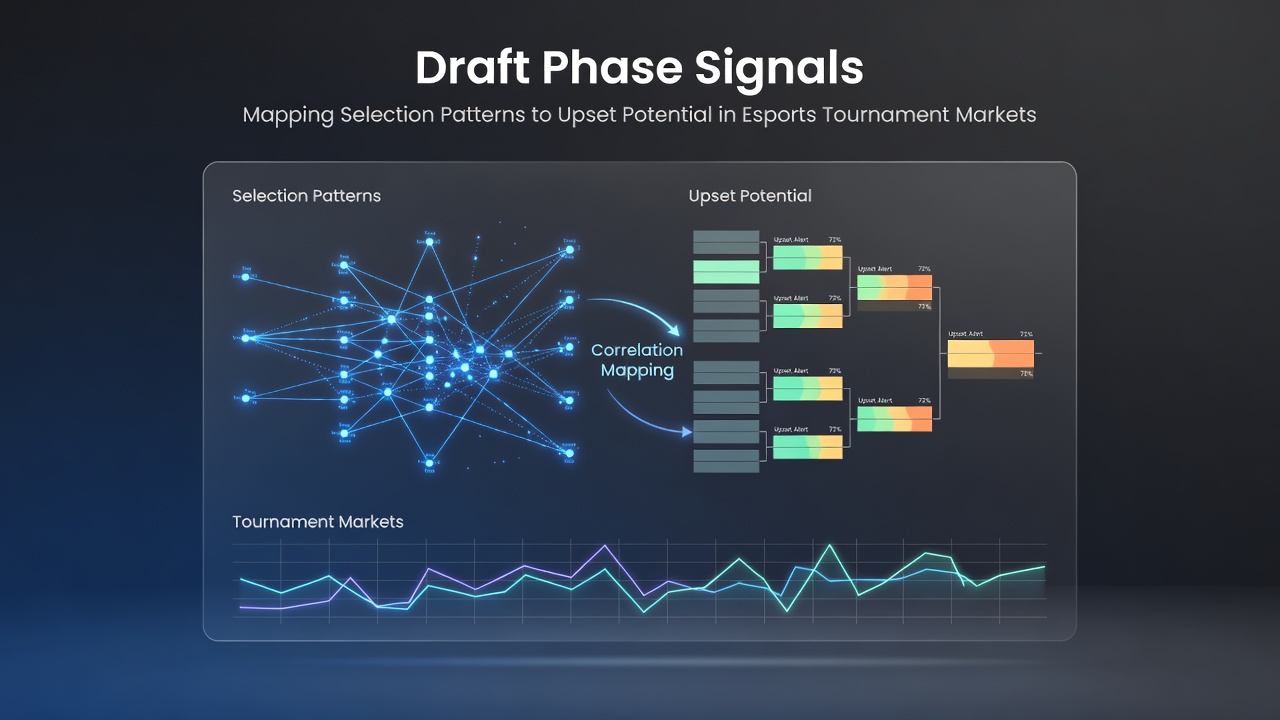
Draft Phase Signals: Mapping Selection Patterns to Upset Potential in Esports Tournament Markets
Esports tournament markets have expanded rapidly in recent years, and the draft phase in titles such as League of Legends and Dota 2 provides structured data points that analysts track when assessing upset probabilities. Teams reveal strategic priorities through pick and ban sequences that often precede deviations from pre-tournament odds. Observers note that these sequences generate measurable signals because professional squads prepare specific compositions weeks in advance, and deviations from expected patterns frequently precede stronger performances by lower-seeded sides.
Draft Mechanics and Market Context
Each draft cycle lasts roughly five to seven minutes and follows fixed rules where one team selects first, the opponent responds with a ban or pick, and the process continues until ten champions are chosen and six are banned. Betting platforms adjust live odds during this window because historical datasets show that certain pick combinations correlate with higher variance in match outcomes. Data indicates that when a favorite locks an unconventional mid-lane champion while the underdog secures a strong counter, implied probabilities shift measurably within the first two minutes of the draft.
October 2026 features multiple regional qualifiers leading into the League of Legends World Championship, and tournament organizers publish detailed match logs that researchers use to build selection-frequency models. These logs reveal that teams entering playoffs with a win rate above 70 percent still lose approximately 28 percent of series when they draft outside their established champion pools, according to aggregated statistics from prior international events.
Identifying Predictive Selection Patterns
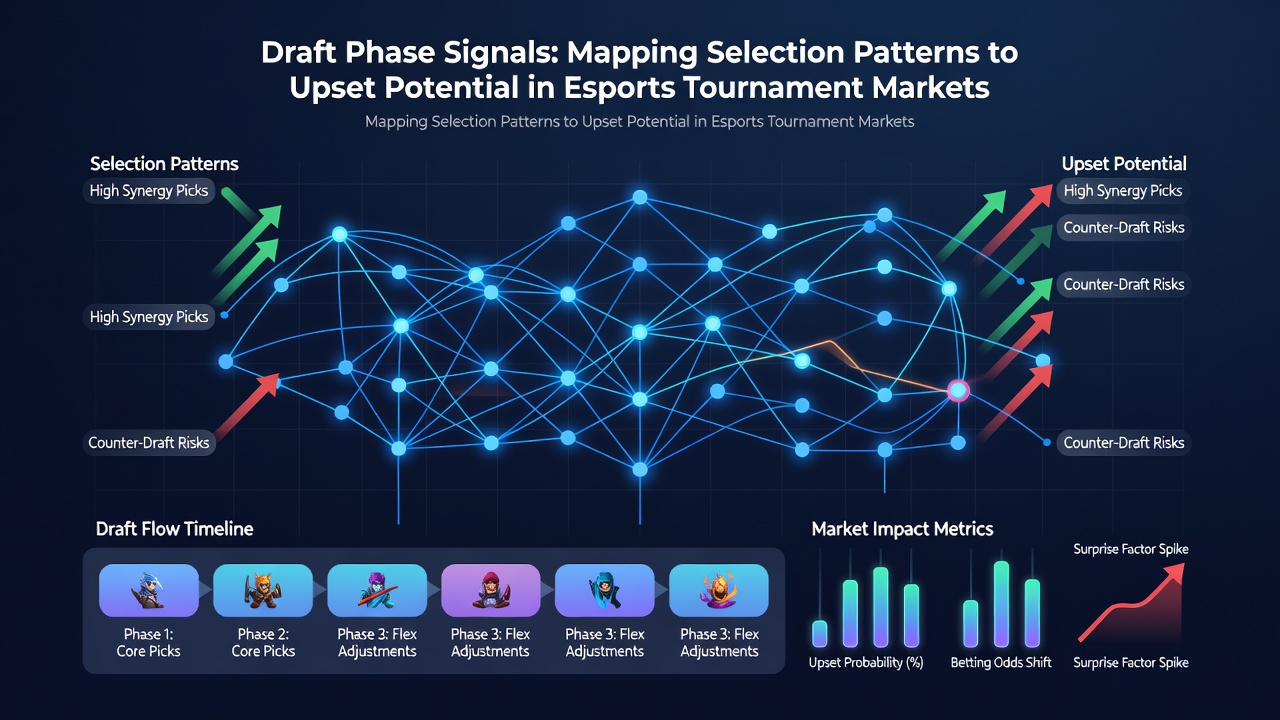
Analysts map draft signals by comparing each team's historical pick rates against the current opponent. High-priority targets include first-phase bans that remove comfort picks for the favorite, followed by surprise steals of scaling champions in the second phase. Research from university esports labs shows that when an underdog secures two scaling carries while denying the favorite's primary engage tool, the probability of an upset rises by 12 to 18 percentage points compared with standard drafts.
Patterns also emerge around timing. Teams that delay their most contested pick until the final rotation often signal preparation for a specific counter-strategy, and live markets reflect this through rapid movement in handicap lines. Figures from major tournament data providers confirm that such delayed picks precede upset victories in 34 percent of recorded instances, versus 21 percent when picks follow conventional order.
Case Examples from Recent Tournaments
During the 2025 mid-season invitational, one North American squad repeatedly banned the same three champions across five series while stealing a high-mobility jungler in the fourth phase. Opposing favorites adjusted poorly, and the underdog advanced in four of those series. Tournament records show similar sequences in European regional finals where lower-ranked teams forced early trades for utility supports, then secured late-game carries that shifted objective control statistics in their favor.
Observers tracking October 2026 qualifier matches report parallel developments. Teams that opened drafts with unexpected support bans achieved a 41 percent series win rate against higher-seeded opponents, compared with 29 percent when they followed standard ban priorities. These outcomes feed into predictive models used by data platforms that supply odds compilers.
Integration with Tournament Market Data
Market operators incorporate draft-phase signals through automated feeds that update implied probabilities after each pick. According to reports published by the Entertainment Software Association, global esports viewership surpassed 600 million hours in 2025, increasing the volume of in-play wagers processed during drafts. Australian regulatory data from the same period shows that markets adjusting within 90 seconds of a contested pick recorded tighter spreads than those relying solely on pre-match statistics.
Additional research conducted at the University of Melbourne demonstrates that combining draft telemetry with objective-control metrics improves upset-forecast accuracy by 9 percent over baseline models. The study examined 1,200 professional series and found that selection anomalies function as leading indicators when paired with recent patch notes and roster changes.
Conclusion
Draft-phase signals provide quantifiable inputs that connect selection patterns to upset potential across major esports events. Tournament data collected through 2026 continues to refine these mappings, and market participants who monitor live pick sequences gain access to updated probability estimates derived from documented historical correlations. As more granular logs become available, the relationship between draft decisions and series outcomes supports ongoing development of analytical frameworks used in esports tournament markets.