Patterns in Penalty Shootout Outcomes and Their Implications for Tournament Stage Wagering Strategies
Ulrich Powell · Sep 18, 2026
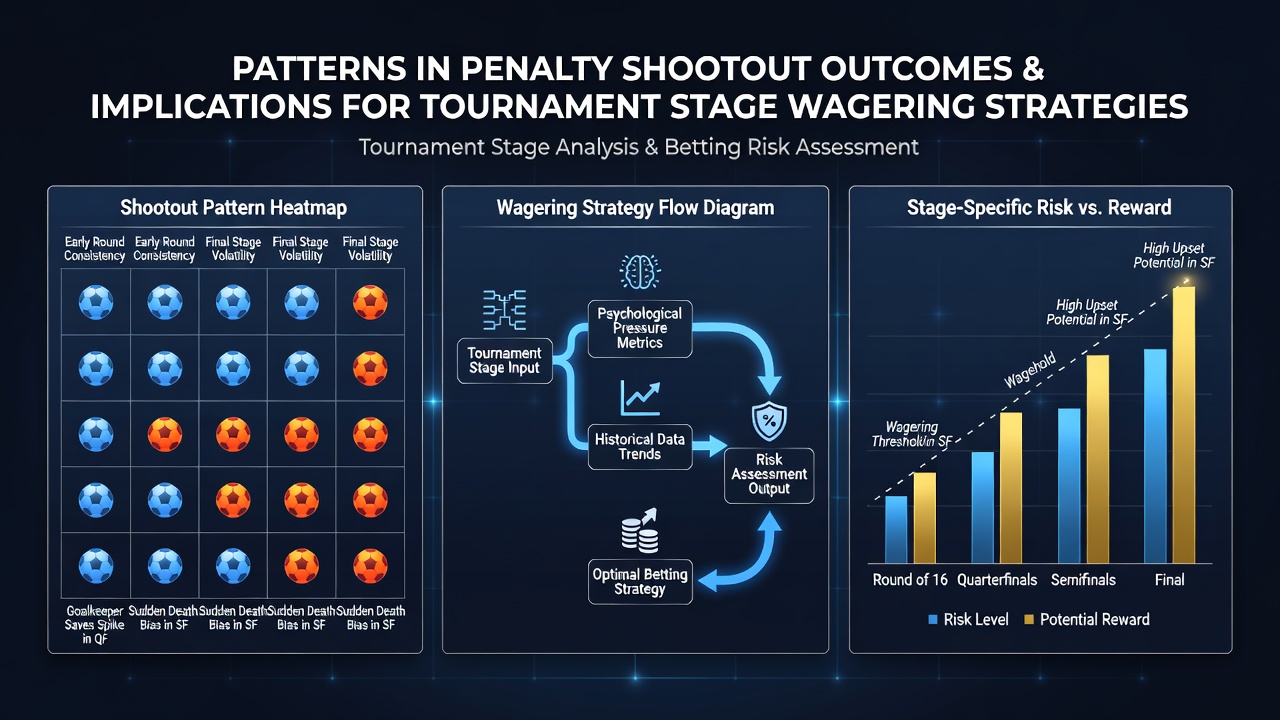
Patterns in Penalty Shootout Outcomes and Their Implications for Tournament Stage Wagering Strategies
Penalty shootouts have become a defining feature of knockout football, where matches that remain level after extra time shift to a sequence of five kicks per team followed by sudden death if necessary. Data compiled across World Cup, European Championship, and Copa America events since 1982 reveals consistent statistical clusters around conversion rates, goalkeeper influence, and sequence positioning. Researchers tracking these outcomes note that first-kick success sits near 78 percent in aggregate records, yet the rate drops to approximately 72 percent for the fifth kick when pressure intensifies. Historical compilations indicate that teams taking the opening kick in a shootout secure victory in roughly 60 percent of cases, a margin that holds across multiple continents and competition formats. This edge appears linked to psychological momentum rather than technical superiority, as subsequent kicks occur under mounting tension once an early lead is established. Observers examining UEFA and CONMEBOL archives have identified similar distributions in both men's and women's tournaments, suggesting the pattern transcends gender and regional playing styles.Key Statistical Clusters in Conversion and Sequence Data
Breakdowns by foot dominance show that right-footed takers maintain a 76 percent success rate while left-footed players reach 81 percent, according to aggregated figures from international governing bodies. The difference stems partly from goalkeeper preparation habits, which tend to favor dives toward the stronger side of right-footed specialists. Additional layers emerge when examining kick order: the second and third positions in the lineup post conversion percentages above 80 percent in most datasets, whereas the fourth and fifth positions fluctuate between 68 and 74 percent depending on whether the scoreline remains tied.
Goalkeeper performance metrics add another dimension. Studies of save rates during official tournament shootouts place elite keepers between 18 and 23 percent, with notable spikes when they face the same opponent twice within a single competition cycle. This repetition effect has been documented in both club and national team contexts, where familiarity with shooting tendencies alters dive selection timing.
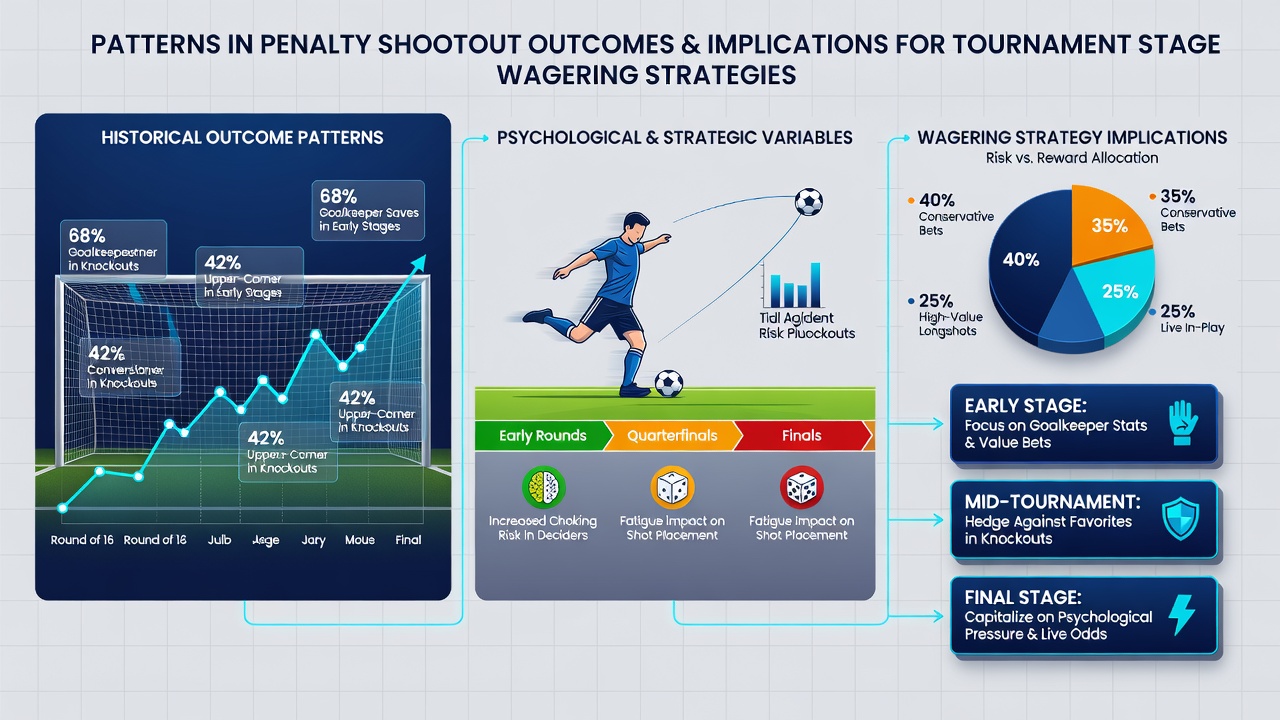
Implications for Tournament Stage Wagering Strategies
Betting markets on knockout stages often adjust odds based on historical shootout participation, yet the underlying patterns suggest value may exist in specific positional and sequence variables rather than broad team reputation alone. Markets that incorporate first-kick advantage or goalkeeper repetition data have shown measurable shifts in implied probabilities compared with those relying solely on overall team rankings. Tournament organizers schedule matches in September 2026 during the final qualification windows ahead of the expanded World Cup, providing fresh datasets that analysts can cross-reference against established conversion trends.
Sequence betting products, such as predicting the exact number of successful kicks or the likelihood of sudden-death extension, reflect these clustered outcomes when operators update lines using real-time historical inputs. Those who monitor live updates during extra time can identify when a match trajectory aligns with documented high-pressure positions, where later kicks carry lower conversion expectations. Regulatory bodies in the European Union and Australia publish periodic integrity reports that track market movements around these events, offering transparent benchmarks for how odds evolve once a shootout becomes probable.
Regional and Competition-Specific Variations
European competitions display slightly higher overall conversion rates than South American equivalents in long-term records, a distinction attributed to differences in training emphasis and pitch conditions rather than player skill disparities. Copa America shootouts since 1993 show a 4 percent lower aggregate success rate, with elevated variance in fifth-kick outcomes. These regional deltas influence how markets price knockout encounters when teams from different confederations meet in intercontinental fixtures.
Academic analyses from institutions in North America and Oceania have examined the role of crowd composition, finding that neutral-venue shootouts reduce the first-kick advantage by approximately 3 percentage points compared with home-soil events. Such findings inform models used by professional syndicates that adjust exposure based on venue and attendance data released prior to quarterfinal and semifinal fixtures.
Conclusion
Patterns emerging from decades of penalty shootout records demonstrate repeatable clusters around kick position, foot dominance, and goalkeeper familiarity. These measurable tendencies carry direct consequences for how markets construct odds during tournament knockout phases. As September 2026 approaches and qualification fixtures generate new shootout instances, updated datasets will continue to refine the precision of sequence-based wagering approaches across global competitions.